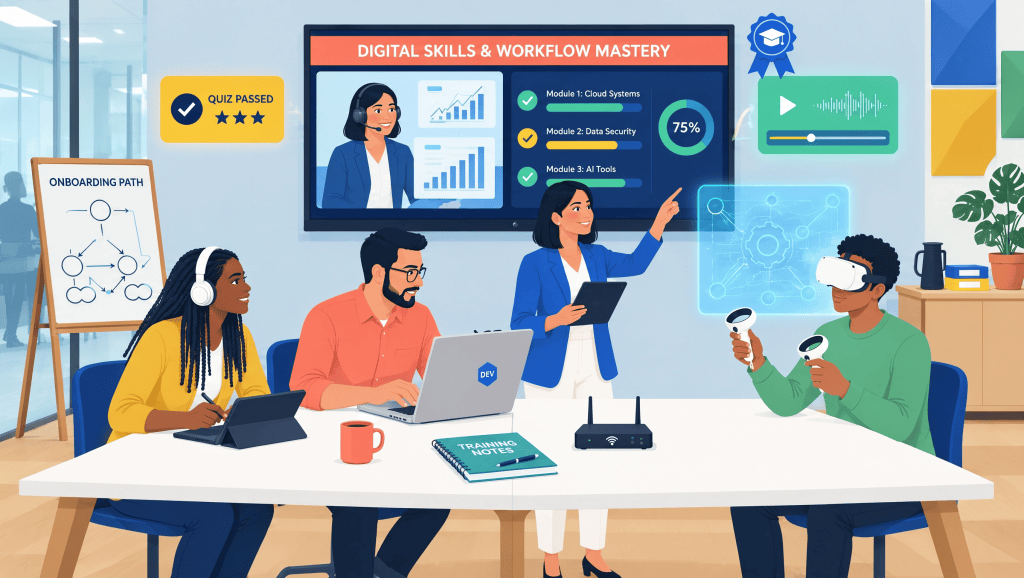
The skills that got your organisation here may not be the skills that take it forward.
The workplace is changing at a pace that is beginning to challenge some long-standing assumptions about what makes employees effective.
Artificial intelligence is changing how work gets done. Digital transformation is creating new responsibilities.
Business models are evolving, job requirements are becoming less predictable, and employees are increasingly expected to take on tasks that would have been outside their original job descriptions just a few years ago.
For organisations, this presents a challenge that goes beyond adopting new technology or filling emerging positions. It raises a much more fundamental question: Does your workforce have the capabilities it will need to remain effective as the nature of work changes?
The numbers suggest that this question deserves considerably more attention.
The World Economic Forum’s Future of Jobs Report 2025, which surveyed more than 1,000 employers representing over 14 million workers across 55 economies, estimates that 39% of workers’ existing core skills will be transformed or become outdated between 2025 and 2030.
That is a substantial amount of workforce capability facing disruption within five years.
The same report found that 63% of employers consider skills gaps a major barrier to business transformation, while 85% plan to prioritise workforce upskilling.
In other words, businesses recognise that the capabilities they need are changing. The challenge is translating that recognition into meaningful changes in how employees are recruited, trained, developed and managed.
And this is where organisations need to start thinking differently.
Understanding the Scale of the Skills Shift
Before looking at individual skills, it is worth understanding what is driving the change.
Several developments are happening simultaneously.
1. Technology is changing the composition of jobs
Artificial intelligence, automation and digital tools are taking over or accelerating certain activities, changing the responsibilities employees spend their time on. In many cases, the role itself is not disappearing, but the capabilities required to perform it effectively are changing.
2. Business requirements are becoming less predictable
Economic uncertainty, changing customer expectations, new regulations and evolving business models mean that organisations must continually reassess what their workforce needs to accomplish.
3. The boundaries between roles are becoming less rigid
Employees are increasingly expected to collaborate across departments, work with unfamiliar tools and contribute to projects outside their immediate responsibilities.
4. Knowledge is becoming easier to access, but harder to evaluate
Employees can retrieve enormous amounts of information quickly. However, determining whether that information is accurate, relevant and appropriate requires judgement and analytical ability.
These developments are changing the relationship between employees, their jobs and the organisations they work for.
What the Numbers Tell Us
The World Economic Forum’s 2025 research provides a useful picture of the scale of the transition:
- 39%: The proportion of workers’ existing core skills expected to be transformed or become outdated by 2030.
- 59%: The proportion of the global workforce that will require training by 2030.
- 85%: The proportion of surveyed employers planning to prioritise upskilling their workforce.
- 63%: The proportion of employers identifying skills gaps as a major barrier to business transformation.
- 70%: The proportion of employers expecting to hire people with new skills between 2025 and 2030.
One particularly interesting finding concerns the scale of the reskilling challenge. Out of every 100 workers, the WEF estimates that 59 will need training by 2030. Of those, 29 could be upskilled in their current roles, 19 could be retrained and redeployed elsewhere within their organisations, while 11 are unlikely to receive the training they need.
The implication is difficult to ignore: organisations that fail to develop their existing workforce may find themselves struggling to fill the capability gaps created by changing business requirements.
The Skills That Are Changing, and What Organisations Need to Understand
The most important distinction to make is that many of the skills employers value are not entirely new.
Critical thinking, communication, creativity and adaptability have always mattered.
What is changing is the level of sophistication with which employees are expected to apply them, the situations in which they must use them, and how frequently they need to develop new capabilities.
Here are the areas organisations should pay particular attention to.
A. AI Literacy and Technological Fluency: From Using Tools to Working Intelligently with Technology
AI is moving beyond specialist technology teams and becoming part of everyday business operations.
Employees in finance, HR, marketing, sales, operations and customer service are increasingly encountering AI-assisted tools that can generate content, analyse information, automate routine tasks and support decision-making.
But simply giving employees access to these tools does not mean they know how to use them effectively.
The emerging requirement is a more comprehensive form of technological literacy.
What Exactly is Changing?
Traditional digital proficiency often involved knowing how to operate workplace software: spreadsheets, databases, collaboration platforms, and industry-specific systems.
The expectations are now expanding.
Employees increasingly need to understand how to work alongside intelligent systems, assess their outputs, and determine when human intervention is necessary.
This involves several distinct capabilities:
1. Effective AI instruction: Knowing how to provide clear instructions, relevant context, and appropriate constraints to AI tools.
2. Output evaluation: Assessing whether AI-generated information is accurate, complete, and suitable for its intended purpose.
3. Human judgement: Recognising when a decision requires professional experience, contextual understanding or ethical consideration that an automated system cannot reliably provide.
4. Responsible technology use: Understanding data privacy, confidentiality, security and the limitations of the tools being used.
5. Workflow integration: Identifying where technology can improve a process rather than using it simply because it is available.
Microsoft’s 2026 Work Trend Index provides an interesting illustration of this change. In its survey of AI users, 50% identified quality control of AI output as a more important human skill as AI takes on more work, while 46% identified critical thinking.
Furthermore, 86% said they treat AI output as a starting point rather than a final answer, retaining responsibility for the thinking.
This suggests that the value employees bring is increasingly tied to their ability to direct, evaluate, and take responsibility for technology-assisted work.
What Organisations Should Do
Introduce role-specific AI literacy programmes.
Avoid giving every employee the same generic AI training. A finance employee, HR professional, and marketing manager will encounter different risks and opportunities.
Training should demonstrate how AI applies to their actual responsibilities.
Establish clear AI usage policies.
Employees should understand which tools are approved, what information can be shared with them, when human review is required and who remains accountable for the final output.
Teach employees to evaluate, not just generate.
Training should include practical exercises in identifying inaccurate information, biased recommendations, fabricated references, and unsuitable outputs.
Measure application, not attendance.
An employee completing an introductory AI course does not demonstrate proficiency. Assess whether they can use the technology appropriately within real workplace scenarios.
The objective is not to turn every employee into an AI specialist. It is to ensure that employees can work effectively and responsibly in an increasingly AI-enabled environment.
B. Critical Thinking and Analytical Reasoning: From Processing Information to Making Sense of It
As technology makes information easier to generate and retrieve, the ability to interpret that information becomes increasingly important.
Employees are no longer simply expected to collect data, follow instructions, or produce reports. They must increasingly understand what information means, identify what is missing, and make informed decisions based on their findings.
This is particularly important in workplaces where AI can produce convincing answers that are not necessarily correct.
What Exactly is Changing?
The shift involves moving from information processing towards information evaluation.
Consider the difference:
| Traditional expectation | Emerging expectation |
|---|---|
| Gather relevant information. | Determine which information is reliable and relevant. |
| Follow established procedures. | Recognise when a procedure is unsuitable for the situation. |
| Prepare reports. | Interpret findings and explain their implications. |
| Identify obvious problems. | Recognise patterns, underlying causes and potential risks. |
| Accept recommendations. | Challenge assumptions and evaluate alternatives. |
Analytical thinking remains the most important core skill identified by employers in the WEF’s 2025 research, with approximately seven in ten companies considering it essential.
This is particularly significant because analytical thinking is not confined to data analysts or senior executives.
An HR professional analysing employee turnover needs to understand what might be driving departures rather than simply report the numbers.
A customer service representative needs to recognise patterns in complaints rather than treat every complaint as an isolated incident.
A manager needs to determine whether declining performance reflects a skills gap, unclear expectations, inadequate resources or a problem with the process itself.
These are all examples of analytical reasoning at work.
What Organisations Should Do
Introduce scenario-based training
Give employees realistic workplace problems and ask them to identify the underlying issue, assess the available evidence and recommend a course of action.
Move beyond knowledge-recall assessments
Knowing the definition of a concept does not demonstrate the ability to apply it. Assessments should test interpretation, decision-making, and problem-solving.
Encourage employees to question processes
Create opportunities for employees to identify inefficiencies, challenge assumptions, and suggest improvements without treating every deviation from established practice as a problem.
Develop analytical capabilities across departments
Do not restrict critical-thinking development to management or technical positions. Every department makes decisions that affect business outcomes.
The goal is to develop employees who can explain not just what happened, but why it happened and what should happen next.
C. Adaptability and Learning Agility: From Performing a Fixed Role to Evolving With It
One of the most important changes in the workplace is that employees can no longer assume their responsibilities will remain static.
New technology, changing customer expectations, restructuring, and business expansion can alter what an organisation needs from a particular role.
An employee may be expected to learn a new system, take responsibility for a different process, or collaborate with a department they have never worked with before.
This makes adaptability more than a personality trait. It is an operational capability.
What Exactly is Changing?
There are several dimensions to this shift.
Learning agility: Employees must become comfortable acquiring new knowledge and applying it to unfamiliar situations.
Role flexibility: Employees may need to take on responsibilities beyond their original job descriptions.
Response to change: Employees must adjust to new processes, systems, and expectations without losing effectiveness.
Transferable capability: Employees need to apply existing knowledge in different contexts rather than relying exclusively on familiar routines.
Continuous improvement: Employees must recognise that their current methods may need to change as better tools and approaches emerge.
The WEF identifies resilience, flexibility and agility among the most important core skills employers value. These capabilities are also expected to continue increasing in importance through 2030.
What Organisations Should Do
Build continuous learning into everyday work
Do not wait for an annual training exercise to address emerging capability gaps. Introduce regular learning opportunities that respond to changing responsibilities and business requirements.
Create opportunities for cross-functional exposure
Allow employees to participate in projects outside their immediate departments, shadow colleagues, and develop a broader understanding of the organisation.
Develop transferable skills
Prioritise capabilities such as communication, problem-solving, digital literacy and project coordination that employees can apply across different roles.
Make learning accessible when responsibilities change
When an employee takes on a new position, introduces new technology or assumes additional responsibilities, provide the training and documentation required to perform effectively.
Normalise the process of relearning.
Employees should understand that updating their knowledge is an expected part of professional development, not an indication that they were previously inadequate.
Organisations that build learning agility into their workforce are better positioned to respond when business requirements change.
D. Creativity and Problem-Solving: From Following Established Processes to Improving Them
As automation takes on more routine tasks, organisations need employees who can contribute something beyond the execution of predefined instructions.
They need people who can identify opportunities, develop new approaches and solve problems that do not have obvious answers.
Creativity is therefore becoming increasingly relevant across roles that have traditionally been associated with structured, repetitive work.
What Exactly is Changing?
The expectation is moving beyond generating ideas.
Employees increasingly need to:
- Identify inefficiencies in existing processes.
- Develop alternative approaches to recurring problems.
- Connect information from different areas of the business.
- Recognise opportunities for improvement.
- Experiment with solutions and evaluate their effectiveness.
- Apply existing knowledge to unfamiliar challenges.
For example, an operations employee may be expected not only to follow a procedure but also to identify why that procedure creates unnecessary delays.
A sales professional may need to develop a different approach to engaging customers when traditional methods stop producing results.
A manager may need to redesign team workflows to accommodate new technology.
The ability to improve how work gets done is becoming an important part of employee contribution.
The WEF identifies creative thinking as one of the skills expected to grow in importance through 2030.
What Organisations Should Do
Make problem-solving part of employee development
Use practical exercises based on challenges employees encounter in their actual roles.
Give employees room to experiment
Create controlled opportunities for employees to test better ways of performing tasks and improving processes.
Reward useful improvements, not just task completion
Recognise employees who identify problems, propose solutions and help implement meaningful improvements.
Develop cross-functional problem-solving
Encourage teams to approach challenges from different departmental perspectives. Problems that appear to belong to one department may have their causes elsewhere in the organisation.
The objective is to build a workforce that understands processes well enough to improve them.
E. Communication, Collaboration and Leadership: From Exchanging Information to Influencing Outcomes
The ability to communicate has always been important. But the nature of workplace communication is changing.
Employees are increasingly expected to work across departments, coordinate with distributed teams, manage stakeholder expectations and communicate complex ideas to people with different levels of expertise.
In many cases, employees must influence outcomes without having formal authority over the people involved.
What Exactly is Changing?
Communication is becoming more closely connected to business execution.
Employees need to:
Communicate with clarity: Explain complex information in ways that different audiences can understand.
Collaborate across functions: Work effectively with colleagues who have different priorities, responsibilities, and expertise.
Manage disagreements: Navigate competing perspectives and resolve conflicts constructively.
Give and receive feedback: Participate in conversations that improve individual and team performance.
Influence decisions: Present ideas, justify recommendations, and build agreement among stakeholders.
Lead through uncertainty: Help colleagues understand changing expectations and remain focused during transitions.
The WEF identifies leadership and social influence among the most important core skills employers value, with its 2025 report showing increased employer recognition compared with 2023.
Importantly, leadership capability is no longer relevant only to employees with managerial titles.
Project coordinators, technical specialists, team leads, and individual contributors all need to influence decisions and work effectively with others.
What Organisations Should Do
Introduce practical communication and feedback training
Use role-play exercises, workplace scenarios and structured feedback sessions to develop employees’ ability to handle difficult conversations.
Develop leadership capabilities at different levels
Do not wait until someone receives a promotion before introducing leadership development.
Build cross-functional learning opportunities
Allow employees to understand how different departments operate and how their work affects wider business objectives.
Equip managers to coach rather than simply supervise
Managers should be able to identify development needs, provide constructive feedback and help employees navigate changing responsibilities.
The organisation benefits when employees can communicate effectively, resolve problems collaboratively and take ownership beyond their immediate job descriptions.
F. Cybersecurity and Data Literacy: From Specialist Responsibility to Shared Accountability
As businesses become increasingly digital, more employees are interacting with sensitive information and systems.
Customer records, financial information, employee data, confidential documents and proprietary business information are no longer handled exclusively by specialist teams.
This expands the responsibility for protecting organisational information.
What Exactly is Changing?
Employees need a stronger understanding of the risks associated with everyday digital activities.
This includes:
- Recognising phishing attempts and social engineering.
- Understanding secure password and authentication practices.
- Handling customer and employee information appropriately.
- Recognising data privacy obligations.
- Understanding the risks of uploading confidential information to unauthorised AI tools.
- Reporting suspicious activity and potential security incidents.
- Interpreting data responsibly and avoiding misleading conclusions.
The WEF identifies networks and cybersecurity as one of the fastest-growing skill categories through 2030.
This reflects the increasing importance of digital infrastructure and the security risks associated with it.
What Organisations Should Do
Make cybersecurity training relevant to each role
A finance employee, HR professional, and sales representative handle different types of information and face different risks. Their training should reflect those differences.
Use realistic simulations
Phishing simulations, data-handling scenarios and incident-reporting exercises help employees practise identifying and responding to potential threats.
Reinforce training regularly
Security risks evolve. Employees need periodic refreshers, especially when new systems, tools or policies are introduced.
Establish clear reporting procedures
Employees should know exactly what to do when they identify a potential breach or suspicious activity.
Cybersecurity should not be treated as a department that protects the organisation on behalf of everyone else. It requires informed participation across the workforce.
G. Knowledge-Sharing and Mentoring: From Individual Expertise to Organisational Capability
One of the most overlooked workplace challenges is the concentration of critical knowledge in individual employees.
An experienced employee may understand how a complex process works, know why certain decisions were made, or possess valuable customer and operational knowledge that is not documented anywhere.
When that employee resigns, retires, or moves into another position, the organisation risks losing more than a person. It may lose knowledge that took years to accumulate.
What Exactly is Changing?
Organisations need to move from relying primarily on individual experience to building systems that make knowledge transferable.
This requires employees to develop the ability to:
- Document important processes.
- Explain procedures to less experienced colleagues.
- Share lessons learned from completed projects.
- Mentor and coach other employees.
- Maintain accurate operational documentation.
- Contribute to internal knowledge resources.
The WEF identifies teaching and mentoring among the skills influenced by changing workforce demographics and highlights the growing importance of talent management, empathy and active listening.
LinkedIn’s 2025 Workplace Learning Report offers another useful perspective. Its analysis of organisations experiencing significant employee turnover identified business strategy, strategic planning, sales management and project planning among the skills most exposed to depletion through employee departures.
These are capabilities that can be difficult to replace because they often depend on accumulated experience and organisational understanding.
What Organisations Should Do
Identify knowledge-critical roles
Determine which positions hold knowledge that would be difficult to replace if the employee left.
Document processes before knowledge becomes inaccessible
Develop standard operating procedures, internal guides, role-specific documentation and process handover materials.
Formalise mentoring and knowledge transfer
Create structured opportunities for experienced employees to share knowledge with colleagues.
Make documentation part of the job
Knowledge-sharing should not be an occasional favour employees perform when they have spare time. It should be recognised as part of their responsibilities.
Keep internal knowledge current
Documentation must be reviewed and updated whenever processes, policies or responsibilities change.
An organisation that successfully transfers knowledge becomes less dependent on individual employees and more capable of maintaining continuity as its workforce evolves.
The Workplace Practices that Must Evolve Alongside these Skills
Developing employees is only one part of preparing for the future.
Organisations must also examine whether their existing management practices, workforce structures and development systems are capable of supporting these changing expectations.
There is little value in asking employees to become more adaptable while maintaining rigid roles, outdated training materials and development processes that rarely change.
Several workplace practices deserve particular attention.
1. Move towards skills-based workforce planning
Traditional workforce planning often begins with headcount and job titles.
Organisations identify the positions they need to fill, determine the qualifications required, and recruit accordingly.
But this approach can overlook the capabilities already available within the workforce.
A skills-based approach begins with a different set of questions:
- What capabilities does the organisation currently possess?
- Which skills will become more important over the next few years?
- Where are the most significant capability gaps?
- Which existing employees could develop into emerging roles?
- Which skills are concentrated in a small number of employees?
Mercer’s 2025/2026 Skills Snapshot Survey, which surveyed 1,077 HR leaders across 72 countries, found that 55% of organisations now map skills directly to jobs, up from 47% in 2023.
It also found that 38% maintain a single enterprise-wide skills library, compared with 30% in 2023.
These figures indicate growing organisational investment in understanding workforce capabilities.
What organisations should do:
Build a skills inventory that identifies the capabilities required across departments and compares them with the skills employees currently possess.
Start with business-critical roles rather than attempting to map every skill in the organisation immediately.
Use the findings to inform recruitment, internal mobility, training and succession planning.
2. Rethink employee training as a continuous process
The traditional approach to employee training is often event-driven.
An employee joins the organisation, attends onboarding, completes mandatory courses and receives additional training when a particular need arises.
But when responsibilities, technologies and business requirements change frequently, this approach can leave employees underprepared.
The alternative is to make learning a continuous part of the employee experience.
This involves:
- Introducing regular skills assessments.
- Providing role-specific learning paths.
- Delivering short, focused training modules.
- Making learning resources accessible when employees need them.
- Providing opportunities to practise new skills.
- Reassessing knowledge after important changes.
- Tracking learning progress over time.
LinkedIn’s 2025 Workplace Learning Report found that 91% of L&D professionals globally agree that continuous learning is more important than ever for career success.
The report also found that 88% of organisations were concerned about employee retention, with learning opportunities identified by respondents as their number-one retention strategy.
The message is clear: learning is increasingly connected to both workforce capability and talent retention.
3. Replace static job descriptions with evolving capability expectations
A job description typically outlines an employee’s responsibilities and the qualifications needed to perform them.
But when jobs evolve, the document can quickly become outdated.
A position that once required employees to manually compile reports may now require them to interpret automated reports, validate AI-generated findings and communicate recommendations to management.
The title may remain the same. The capabilities required to perform the job effectively have changed.
Organisations should therefore review job requirements regularly and distinguish between:
- Core responsibilities that remain essential.
- Emerging responsibilities created by new technology or business needs.
- Skills that employees need to acquire.
- Skills that may become less relevant.
- Transferable capabilities that could support movement into other roles.
This also creates opportunities for internal mobility.
The WEF found that 51% of surveyed employers expect to transition employees from declining roles into growing roles within their organisations by 2030.
Rather than treating every emerging capability gap as a recruitment problem, organisations can develop existing employees to meet new requirements.
4. Make performance management more developmental
Performance management should not only establish whether employees are meeting expectations. It should also help identify what they need to improve and how the organisation can support that improvement.
This requires managers to have more regular conversations about:
- Skills employees are developing.
- Challenges affecting their performance.
- New responsibilities they are taking on.
- Areas where additional training is needed.
- Progress against development objectives.
An annual appraisal can provide a useful summary, but it should not be the only opportunity to discuss employee development.
Organisations should establish more frequent feedback mechanisms and connect performance discussions to practical development plans.
5. Treat organisational documentation as a strategic asset
As businesses grow, processes become more complex and institutional knowledge becomes increasingly distributed.
Yet many organisations still rely on informal communication, disconnected documents and individual employees to explain how things work.
This creates unnecessary operational dependency.
A more deliberate approach involves centralising important organisational knowledge, maintaining version-controlled documentation and ensuring employees can access accurate information relevant to their responsibilities.
This is especially important for:
- Onboarding.
- Compliance and policy management.
- Standard operating procedures.
- Departmental processes.
- Role-specific training.
- Handover and succession planning.
Documentation should not simply exist. Employees need to understand it, know where to find it and be able to apply it.
A Practical Roadmap: How to Prepare Your Organisation for the Skills Shift
Recognising the changes ahead is important. Building an organisational response is what makes the difference.
The following roadmap provides a practical starting point for HR leaders, business owners and management teams.
Step 1: Identify the Capabilities Your Business Will Need
Begin with your business strategy.
What is the organisation planning to achieve over the next three to five years? Is it expanding into new markets, introducing AI, improving operational efficiency, launching new services, or changing its business model?
Each of these decisions has implications for the workforce.
For example:
| Business priority | Capabilities the workforce may need |
|---|---|
| AI adoption | AI literacy, critical thinking, output evaluation and data protection |
| Digital transformation | Technological literacy, adaptability and cybersecurity awareness |
| Business expansion | Communication, commercial awareness, leadership and problem-solving |
| Operational efficiency | Analytical thinking, process improvement and digital proficiency |
| Regulatory compliance | Risk awareness, policy understanding and role-specific compliance knowledge |
| Customer experience improvement | Communication, empathy, conflict resolution and customer analysis |
Do not assume that every emerging skill is equally important to your organisation.
Prioritise capabilities according to your industry, business model, regulatory obligations and strategic direction.
Step 2: Conduct a Workforce Skills Assessment
Once you understand what the organisation will need, establish what it currently has.
This requires more than asking employees to list their skills.
Assess capabilities through a combination of:
- Employee self-assessments.
- Manager evaluations.
- Practical skills assessments.
- Performance data.
- Work samples and project outcomes.
- Professional qualifications and certifications.
- Training records.
Distinguish between skills employees claim to possess, skills they can demonstrate, and skills they need to develop.
Create a simple capability matrix showing the skills required for each critical role and the current proficiency levels of employees performing those roles.
This gives management a clearer picture of where the organisation is prepared and where intervention is needed.
Step 3: Prioritise the Gaps that Matter Most
Not every skills gap needs immediate attention.
Some may affect business continuity, regulatory compliance or operational performance. Others may relate to capabilities the organisation expects to need in the future.
Prioritise gaps using three considerations:
Business impact: How significantly does the missing capability affect organisational performance?
Urgency: How soon will the organisation need this capability?
Development feasibility: Can the capability realistically be developed internally, or will external recruitment be necessary?
This helps prevent organisations from investing in training simply because a particular skill is trending.
Training should address an identifiable business need.
Step 4: Build Role-Specific Development Plans
Once priorities are established, translate them into practical learning objectives.
A development plan should identify:
- The skill an employee needs to develop.
- The expected proficiency level.
- The learning resources required.
- The practical activities through which the skill will be developed.
- The person responsible for supporting development.
- How progress will be assessed.
- When proficiency will be reviewed.
For example, an organisation introducing AI-assisted workflows may establish different learning objectives for its HR, finance and marketing teams.
The HR team might need to understand responsible AI use in recruitment and employee data management.
Finance employees might need to develop capabilities in evaluating AI-generated forecasts and identifying anomalies.
Marketing employees might need training in AI-assisted content production, fact-checking, and brand governance.
The underlying technology may be the same, but the required capabilities differ.
Step 5: Redesign Training Delivery
Training should be accessible, relevant, and sufficiently flexible to accommodate changing responsibilities.
A combination of learning approaches is often more effective than relying exclusively on classroom sessions or lengthy documents.
Consider incorporating:
Short learning modules: Break complex subjects into manageable lessons employees can complete without disrupting their entire workday.
Interactive assessments: Use quizzes, scenarios, and practical exercises to establish whether employees understand what they have learned.
Learning paths: Organise training according to job roles, departments, experience levels, and development objectives.
Peer learning: Encourage employees to share knowledge and learn from colleagues with relevant expertise.
Practical application: Give employees opportunities to apply newly acquired skills to real workplace situations.
Refresher training: Reinforce important knowledge and address changes to policies, systems, and responsibilities.
The objective is to move from simply delivering training to building capabilities that employees can demonstrate.
Step 6: Equip Managers to Support Development
Managers play a significant role in determining whether employee development translates into improved workplace performance.
They are often best positioned to recognise emerging capability gaps, observe how employees apply their skills and identify where additional support is needed.
However, managers also need the skills to perform this responsibility effectively.
Provide them with guidance on:
- Identifying individual development needs.
- Giving constructive feedback.
- Coaching employees through new responsibilities.
- Supporting cross-functional development.
- Recognising performance and knowledge gaps.
- Encouraging continuous learning.
Development should not be treated as something HR owns independently of the rest of the organisation.
Managers need to participate in identifying needs, reinforcing learning and evaluating its application.
Step 7: Document and Preserve Organisational Knowledge
As employees develop new capabilities and processes evolve, ensure that important knowledge is captured and made accessible.
This includes documenting:
- Updated procedures.
- New technology workflows.
- Role-specific responsibilities.
- Internal policies.
- Training resources.
- Lessons learned.
- Compliance requirements.
Assign ownership for reviewing and updating important documentation.
A document that no one maintains can quickly become a source of confusion rather than a useful resource.
Step 8: Measure Whether the Organisation is Becoming More Capable
Training completion is useful information, but it does not establish whether employees have developed the capabilities the business needs.
Organisations should measure both learning activity and its application.
Consider tracking:
| Measurement area | What to monitor |
|---|---|
| Training participation | Enrolments, attendance and completion rates |
| Knowledge retention | Assessment scores and refresher performance |
| Skill development | Changes in proficiency levels over time |
| Capability gaps | Number and severity of outstanding skill gaps |
| Application | Evidence that employees are using new skills at work |
| Internal mobility | Employees moving into new roles or responsibilities |
| Knowledge management | Documentation coverage, accuracy and review status |
| Business outcomes | Improvements in quality, productivity, efficiency or risk management |
Review these indicators regularly and use the findings to adjust development priorities.
A training programme should not be considered successful simply because employees completed it. Its success should be evaluated against the capabilities and outcomes it was designed to improve.
A 90-Day Starting Plan for Organisations
For organisations that have not yet developed a structured approach to workforce capability planning, a 90-day exercise can help establish the foundations.
Days 1–30: Understand the current position
- Review the organisation’s strategic priorities.
- Identify roles and departments likely to experience significant change.
- Identify the most important emerging skills for the business.
- Review existing training programmes and documentation.
- Consult department heads and managers about capability gaps.
- Identify critical knowledge that is currently concentrated in individual employees.
Deliverable: An initial workforce capability assessment highlighting priority areas.
Days 31–60: Design the response
- Establish priority skills for each relevant role.
- Define expected proficiency levels.
- Develop role-specific learning objectives.
- Identify appropriate training methods and resources.
- Establish documentation and knowledge-sharing requirements.
- Assign responsibility for implementation.
- Define how learning and skill development will be measured.
Deliverable: A practical workforce development plan.
Days 61–90: Implement and evaluate
- Launch a pilot training programme in selected departments.
- Introduce practical skills assessments.
- Establish regular manager-employee development conversations.
- Document important processes and update existing resources.
- Track participation, assessment results and early evidence of skill application.
- Gather employee and manager feedback.
- Refine the programme before expanding it.
Deliverable: An initial skills development programme with measurable objectives and a process for continuous improvement.
The 90-day period is a starting point, not a deadline for completing an organisation-wide transformation. Building a capable workforce requires ongoing assessment and adjustment.


Leave a Reply