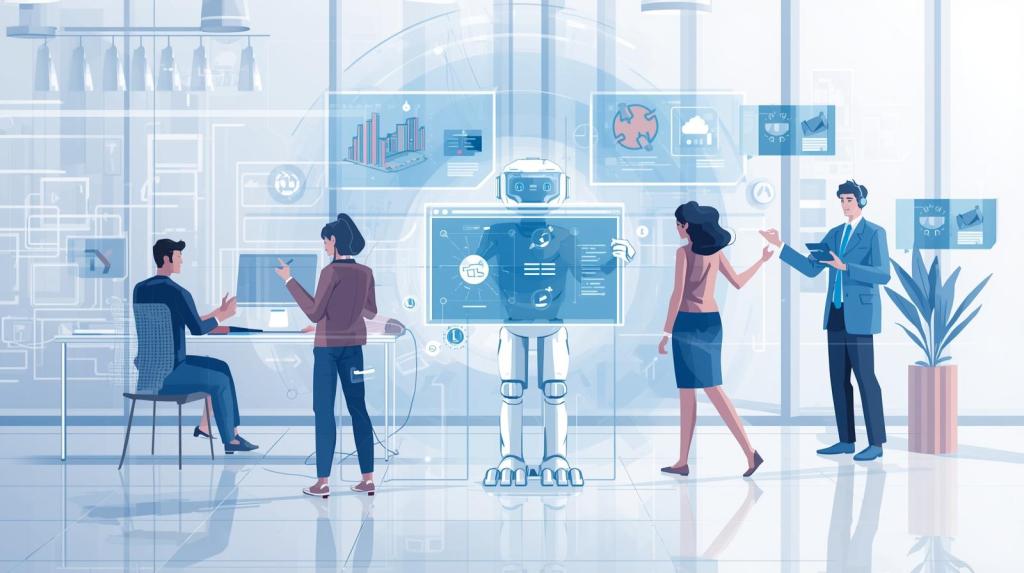
AI is already at work; screening candidates, shaping decisions, nudging performance, and quietly rewriting job roles. The problem isn’t that organisations are slow to adopt it. The problem is that they’re adopting it faster than they’re preparing the people expected to live with it.
Employees aren’t waiting to be convinced. Most already believe AI makes them better at their jobs, and many are using it more than leadership realizes. Yet anxiety, skill gaps, and distrust persist, not because AI is too advanced, but because workplaces are structurally unready for what it changes.
This article examines the widening gap between AI adoption trends and workforce preparedness; why organisations are moving faster than their people systems, where leaders are misreading employee readiness, and what it actually takes to build a workforce that doesn’t just survive AI, but gains leverage from it.
What Are the Latest AI Adoption Trends in the Workplace?
1. AI Use is Already Mainstream Across OECD Economies
OECD survey data shows that a majority of firms across OECD countries are already using AI in at least one business function, with adoption highest in information processing, forecasting, customer interaction, and HR-related decision support. Importantly, AI use is no longer limited to advanced digital firms; it is spreading across traditional sectors as well.
Key signal: AI adoption has moved from “frontier firms” to ordinary workplaces.
2. Workers Report Higher AI Usage Than Employers Assume
Worker surveys reveal a consistent pattern: employees report using AI tools more frequently than employers report deploying them. This indicates widespread informal or untracked AI usage, particularly generative AI for writing, summarisation, translation, and decision support.
This is reinforced by McKinsey’s report, which finds that most employees who use AI say it improves their productivity and quality of work, even in the absence of formal training or organisational strategy.
Key Signal: AI adoption is increasingly bottom-up, not top-down.
3. AI is Affecting Tasks at Scale, Not Eliminating Jobs
Academic studies show that AI impacts a significant share of tasks within jobs, rather than entire occupations. Multiple studies estimate that 20–40% of tasks within many knowledge-intensive roles are technically automatable, while the remaining tasks increase in complexity and cognitive demand.
Key Signal: AI adoption is widespread at the task level, even where job titles remain unchanged.
4. Generative AI is Accelerating Adoption Faster Than Previous AI Waves
OECD analysis notes that generative AI has dramatically lowered barriers to adoption, enabling non-technical workers to use AI directly without intermediaries. This represents a structural shift from earlier AI systems that required specialised implementation and expertise.
This accessibility is why AI diffusion is occurring faster than organisations can update training, governance, or job design.
Key Signal: Adoption speed is outpacing organisational readiness.
5. Large Firms Are Adopting Faster, but SMEs Are Catching Up
OECD data confirms that large firms are more likely to adopt AI due to capital, data access, and infrastructure. However, generative AI tools are narrowing this gap, allowing small and medium-sized enterprises to adopt AI capabilities without heavy upfront investment.
Key Signal: Cost and complexity are no longer the primary adoption barriers.
6. Management Use of AI for Monitoring is Rising
OECD also reports increasing use of AI in performance monitoring, task allocation, and workforce analytics, particularly in platform-mediated and digitally managed work. Research links this trend to rising concerns around autonomy, trust, and algorithmic opacity.
Key Signal: Adoption is expanding not just in doing work, but in managing workers.
7. Training Lags Far Behind Adoption
One of the most striking findings: only a minority of workers using AI report receiving formal training. Yet OECD data shows that workers who do receive training report significantly better job quality outcomes and lower anxiety about AI.
Key Signal: High adoption, low preparedness.
Why Is There a Gap Between AI Adoption and Employee Readiness?
The plain truth is that AI is being deployed faster than work, skills, and management practices are being redesigned to support it.
Here’s what the evidence shows.
1. AI is Adopted as a Technology Project, not as Workforce Transformation
Most organisations introduce AI through IT, innovation, or operations teams, treating it as a tool to deploy rather than a system that reshapes work itself. As a result, AI is implemented without parallel investment in role redesign, skills development, or change management.
Academic studies confirm that when AI adoption is framed narrowly as automation or efficiency, employee readiness consistently lags because workers are expected to “adapt on the fly”.
2. Training Significantly Lags Behind Usage
Survey data show that only a minority of workers using AI have received formal training, even though many already interact with AI systems in their daily work. This creates a situation where employees are exposed to AI but not equipped to use it effectively or confidently.
Crucially, evidence also shows that workers who receive AI-related training report better job quality outcomes, lower anxiety, and higher trust in AI systems, yet training remains the exception, not the norm.
3. Employees Are Using AI Faster Than Organisations Acknowledge
Both OECD data and reports from McKinsey show that employees often adopt AI tools informally, especially generative AI, without official guidance or oversight. Leaders systematically underestimate how widely AI is already being used by staff.
This creates a readiness illusion: organisations believe employees are “not ready,” while employees are already experimenting, just without guardrails, clarity, or support.
4. Job Design has not Kept Up with Task-Level Change
AI adoption primarily affects tasks, not entire jobs, with studies estimating that 20–40% of tasks in many knowledge roles are technically automatable. However, most organisations fail to formally redesign roles to reflect this shift.
Instead of redefining responsibilities, decision rights, and performance expectations, AI is layered onto existing jobs, leaving employees uncertain about what is expected of them and where human judgment still matters.
5. Trust Erodes When Transparency is Missing
OECD findings show that a lack of transparency around how AI systems make or inform decisions, especially in hiring, evaluation, and monitoring, significantly undermines employee trust. Where AI influences outcomes without explanation, readiness drops, even when productivity gains are possible.
Research links opaque AI systems to increased stress, resistance, and disengagement among workers, particularly when AI is perceived as a surveillance or control mechanism.
6. Governance has not Caught Up with Use
There are growing risks related to bias, discrimination, data protection, and excessive monitoring, especially where AI is adopted faster than internal governance frameworks are developed. When safeguards are unclear or inconsistent, employee confidence drops.
Studies show that perceived unfairness or unaccountable AI systems directly reduce acceptance and readiness.
7. AI is Framed as a Threat Instead of an Amplifier
The Superagency framework shows that organisations that frame AI as a cost-cutting or replacement tool experience more resistance and anxiety. In contrast, when AI is positioned as a way to expand human capability, readiness, and adoption quality improves.
Yet most organisations have not shifted this narrative, leaving employees uncertain about whether AI is meant to help them or replace them.
What Skills Do Workers Need to Be Ready for AI Integration?
AI integration demands a layered skill set that blends technical understanding, human judgment, and organisational literacy.
Here’s what the research shows workers actually need.
1. Basic AI Literacy and Understanding of System Limits
The OECD identifies AI literacy as a foundational requirement for readiness. Workers need to understand:
- What AI systems are designed to do
- Where errors, bias, or hallucinations can occur
- Why AI outputs require interpretation, not blind trust
OECD survey evidence shows that workers with a greater understanding of AI systems report higher confidence, better job quality, and lower anxiety when AI is introduced. Importantly, this literacy does not require technical or coding expertise.
2. Critical Thinking and Human Judgment
Research consistently shows that AI shifts human work up the value chain, from execution to evaluation. As AI automates prediction, classification, and pattern recognition, workers are increasingly responsible for:
- Assessing AI recommendations
- Identifying errors or inappropriate outputs
- Making final decisions in ambiguous or context-sensitive situations
Research also warns that automation bias, over-trusting AI outputs, is a significant risk when critical thinking skills are weak.
The Missing Layer in Most AI Strategies: Workforce Enablement
When work changes this fast, informal knowledge stops working. What used to be explained once now needs to be learned, reinforced, and revisited.
Teams that recognise this early don’t panic about adoption; they fix the learning layer underneath it.
That’s where tools like Varsi earn their place:
- Turn evolving processes into living training paths
- Reinforce understanding with AI-generated quizzes
- Automate assignments and follow-ups without the chase
- Keep knowledge accessible, current, and auditable
- See who’s keeping up, and where support is needed
AI changes the pace of work. Learning has to match it. The rest is noise. See how leading teams train ahead…
3. Task-Level Adaptability and Role Flexibility
A central finding is that AI affects tasks rather than entire occupations. A significant amount of tasks within many knowledge-intensive roles are technically automatable, while the remaining tasks grow in complexity and judgment requirements.
As a result, workers need the ability to:
- Recombine tasks as automation expands
- Adjust workflows as AI tools evolve
- Operate effectively in hybrid human–AI task structures
OECD evidence shows smoother transitions where workers can adapt at the task level rather than being locked into rigid job definitions.
4. Human-Centric Skills that AI does not Replicate
As AI takes on more routine cognitive tasks, academic research consistently shows rising importance for skills that remain distinctly human, including:
- Communication and collaboration
- Emotional intelligence and empathy
- Creativity and problem framing
- Ethical reasoning and accountability
Studies show these skills become more valuable, not less, as AI systems increase in capability, because humans retain responsibility for meaning, impact, and social consequences.
5. Ethical Awareness and Responsible AI Use
OECD research highlights growing workplace risks related to bias, discrimination, privacy breaches, and excessive monitoring when AI is poorly governed. Workers, therefore, need:
- Awareness of ethical risks
- Understanding of organisational AI rules and safeguards
- Confidence to question or escalate problematic use
OECD evidence shows that trust and acceptance of AI are higher where workers understand how AI is governed and what protections exist.
6. Human–AI Collaboration Skills (“working with AI”)
Readiness should be framed around the idea of superagency, the ability to use AI to expand human capability rather than replace it. This requires skills such as:
- Guiding and prompting AI systems effectively
- Integrating AI outputs into human decision-making
- Knowing when human judgment must override automation
Organisations that cultivate these skills are more likely to realise productivity gains and positive employee experiences.
7. Role Clarity and Accountability Awareness
OECD findings show that readiness improves when workers clearly understand:
- How AI affects their role
- Where responsibility lies between human and system
- How performance is evaluated when AI is involved
Where this clarity is missing, anxiety, resistance, and disengagement increase, even among skilled workers.
Can AI Replace Human Jobs, and What Does That Mean for Workers?
There is a strong consensus that AI’s labour impact operates at the task level, not the job level. As mentioned earlier, multiple studies estimate that 20–40% of tasks within many occupations are technically automatable, particularly routine, predictable, and data-driven activities.
However, very few occupations are fully automatable. Most jobs combine automatable tasks with non-automatable ones that require judgment, social interaction, creativity, or contextual reasoning; areas where humans retain a clear advantage.
OECD survey data show that a significant share of workers worry about job displacement due to AI, especially in roles exposed to monitoring, algorithmic decision-making, or automation of routine tasks
Yet the same OECD evidence indicates that actual job loss directly attributable to AI remains limited, particularly compared to the scale of task reconfiguration already underway. In other words, perceived risk currently exceeds observed displacement.
What Does the Future of Work Look Like With AI?
The future of work with AI is not a world run by machines, but one defined by how well humans are prepared to work alongside them. AI will continue to absorb routine tasks, expand managerial oversight, and reshape what “good work” looks like, but responsibility, judgment, and accountability will remain human.
The organisations that win will not be the fastest adopters, but the most intentional: those that invest in skills, redesign work, and use AI to amplify human capability.
 blog.tryvarsi.com
Leave a comment