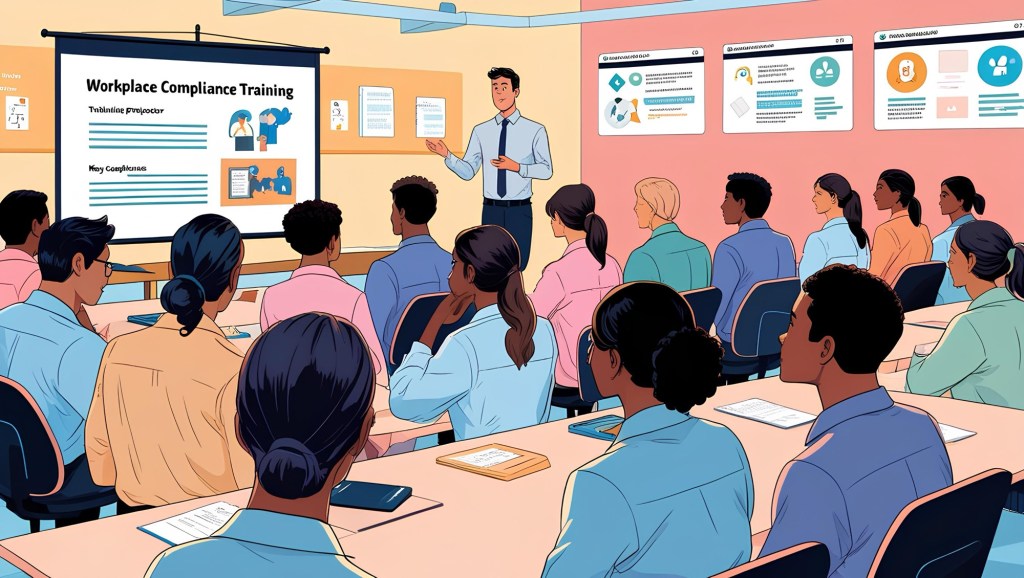
Mandatory training: the one thing standing between you and a very hefty fine, or worse, a federal awsuit. Also… a golden opportunity to empower your team, sharpen skills, and build a smarter, and stronger workplace.
Training, when done right, can be a powerful tool for employee upskilling, but you’d have to admit that more often than not, it starts with a frantic Google search that goes something along the lines, “what trainings are legally required so we don’t get sued?”
The truth is, legally required employee training is both a compliance box to check and a chance to create a better-informed, safer workplace. It doesn’t have to be either-or.
In this article, we’re breaking down the top 8 trainings you’re actually required to provide, plus how to stay compliant without losing your mind (or your margin).
What Federal Trainings Are Legally Required For Every Workplace?
While the U.S. government does not impose a single universal training requirement for all workplaces, it does mandate certain trainings based on the nature of a job, the risks involved, and the employer’s obligations under specific laws.
Rather than a one-size-fits-all checklist, federal training requirements function more like a legal safety net; if a workplace presents certain risks or falls under certain legal categories, then relevant training becomes mandatory.
Here’s a simple overview of all the employee trainings required by law here in the USA:
1. Occupational Safety (OSHA)
Ah, OSHA. The government agency that ensures your employees don’t leave work with fewer limbs than they arrived with. OSHA-mandated trainings cover everything from hazardous materials to emergency action plans. Here’s what you need to know:
- Hazard Communication (HazCom): For any employee working with or around hazardous chemicals. Train on hire and when new hazards are introduced.
- Personal Protective Equipment (PPE): Covers the proper use, maintenance, and limitations of protective gear. Required at assignment and reviewed periodically.
- Respiratory Protection: Includes fit-testing and proper care. Train on hire, refresh annually.
- Emergency Action Plan & Fire Extinguisher Use: Because chaos isn’t a strategy. Train during onboarding, role changes, and whenever plans update.
- Bloodborne Pathogens: Required for anyone at risk of exposure to blood or bodily fluids. Initial training, plus updates.
- Hearing Conservation: For employees exposed to loud environments (≥ 85 dB). Includes audiometric testing and yearly training.
- HAZWOPER: For those dealing with hazardous waste. Extensive initial training with annual refreshers.
- Lockout/Tagout: For staff servicing or maintaining equipment. Required training at assignment, with refreshers as needed.
- Powered Industrial Trucks: Think forklifts. Operators must be certified initially and evaluated every three years.
- Construction-Specific Training: For high-risk roles like scaffolding, trenching, and asbestos handling. Frequency depends on risk level.
2. Data Privacy & Security
If your business handles sensitive data (we’re in the digital age, it’s virtually impossible not to), you’re legally required to keep it locked down. That means training your team not to click on sketchy links or leave a laptop full of PHI in a coffee shop.
- HIPAA Security & Privacy Training: For any staff handling protected health information. Initial and annual updates required.
- Information Security Awareness: Applies under GLBA, PCI DSS, FISMA. Covers cybersecurity hygiene, phishing awareness, and data handling. Required annually.
So what cybersecurity training platforms actually help enterprise teams maintain regulatory compliance? Look beyond generic security awareness videos.
The platforms worth considering offer role-based training paths (your finance team needs different modules than your developers), built-in compliance tracking with timestamps, and audit-ready reporting you can pull in seconds—not days.
Varsi handles this with role-specific training assignments, real-time completion tracking, and exportable compliance reports, so when auditors ask for proof your team completed required security training, you’re not digging through spreadsheets.
3. Employment & Labor Law Training
Labor law violations can be expensive. So if your managers don’t know when they legally owe training pay (hint: often), you’re gambling with fines.
- FLSA Compliance for Supervisors: Required to ensure training time is properly compensated, even if it’s off the clock or outside regular duties.
Your Compliance Safety Net, Meet Varsi
Varsi takes the mess off your plate and replaces it with structure, visibility, and ease.
Here’s how it works:
✓ Deliver training effortlessly
Create or upload courses, assign in clicks, and reinforce with tools like: AI Powered Quizzes, Flipcards, Open-ended questions, and Feedback blocks.
✓ Track everything automatically
Varsi captures: Completion status, Time spent per section, Number of attempts, Learner progress, all of which are exportable to a CSV file or spreadsheet.
✓ Get real insights, not just checkboxes
Our analytics help you: Spot trends, Identify training gaps, and Tie learning activity to performance and outcomes
✓ Stay audit-ready, always
Your documentation is built in, so you don’t have to scramble for records when it matters most.
Make compliance one less thing to worry about. Try Varsi today.
4. Sexual Harassment Training
Federal law doesn’t explicitly require this for all employers, but if you want to avoid liability under Title VII, it’s strongly encouraged. And in many states, it’s 100% mandatory.
States & Local Mandates:
- California: 5+ employees, every 2 years.
- New York: All employers, annually.
- Connecticut: 3+ employees, every 10 years.
- Delaware: 50+ employees, every 2 years.
- Illinois: All employers, annually.
- Maine, Washington, D.C., and others: Have their own unique training timelines.
5. Diversity, Equity & Inclusion (DEI) Training
While not federally required, DEI training is increasingly part of legal and contract compliance for certain employers. Plus, it’s just good business.
- Mandated for: Federal contractors (Executive Order 11246), some state/local contracts.
- Best Practice: Many private employers adopt DEI training to reduce bias, improve workplace culture, and meet ESG goals.
6. Workplace Ethics & Code of Conduct Training
Ethics training isn’t just about doing the right thing. In certain industries, it’s about doing the legal thing.
- Required for:
- Federal contractors (FAR 52.203-13)
- Publicly traded companies under Sarbanes-Oxley and FCPA (especially anti-bribery/compliance training)
- Industries with fiduciary obligations (finance, healthcare, etc.)
7. U.S. Department of Transportation (DOT) Training
If you operate commercial vehicles, DOT training is your non-negotiable.
- Required Training:
- 1 hour on alcohol misuse
- 1 hour on drug use recognition (for supervisors)
- Applies to: Trucking, airlines, rail, transit, pipelines, commercial vessels
8. Drug-Free Workplace Training (Federal Contractors & Grantees)
Thanks to the Drug-Free Workplace Act, employers with federal contracts or grants must implement and communicate a substance-free policy.
- Requirements:
- Create a clear drug-free policy
- Provide awareness education
- Explain access to counseling or rehab services
What Counts As “Effective Documentation” Of Compliance Training?
You know that spreadsheet HR created for tracking trainings?
The one where employees are supposed to check off that they’ve completed a session… but half the time forget, and the other half click “yes” whether they did or not? Yeah, that’s not compliance.
When it comes to legally required training, the law expects more than a casual spreadsheet and good intentions. Here’s what counts as effective documentation:
- Attendance Records: Sign-in sheets (physical or digital), with timestamps. Bonus points if tied to your LMS.
- Completion Certificates: Issued by your training provider or system, especially important for state-mandated trainings.
- Proof of Understanding: Quizzes, scenario-based assessments, or interactive modules that demonstrate comprehension.
- Refreshers Tracked by Date: Many laws require annual or biennial retraining. Set reminders and keep a record of re-completions.
- Policy Acknowledgment Forms: Especially for things like harassment or ethics training. Employees should sign that they’ve read and understood relevant policies.
 blog.tryvarsi.com
Leave a comment